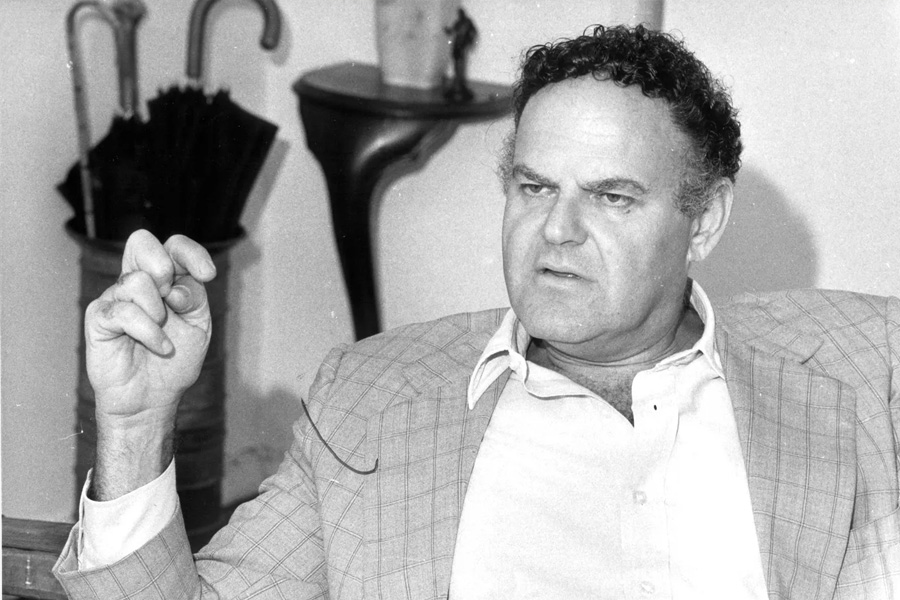
Early Life and Family Background
George Irving Shelasky was born in Springfield, Massachusetts, on November 1, 1922. Born to haberdasher Abraham Shelasky and homemaker Rebecca Shelasky, he was raised in a Russian Jewish immigrant household. One of four siblings, his three siblings’ identities and later lives are mostly unknown.
Irving came to music early. He sung as a boy soprano in synagogues and churches at 13 or 14. His adolescent voice grew into his signature rich, resonant baritone.
Drama and Shakespeare and Chekhov were taught at Springfield’s Classical High School. He was awarded a Boston Leland Powers School of Theater scholarship in 1940. Young men with strong voices, towering stature, and no military draft age were desirable to the institution.
Career development began in the early 1940s. He sang in Show Boat and Girl Crazy with the St. Louis Municipal Opera chorus in 1942. Irving unexpectedly appeared when an actor lost his voice during a Show Boat rehearsal. Irving met Oscar Hammerstein II working on the production, which shaped his career.
George S Irving and His Broadway Breakthrough
Irving made his Broadway debut in 1943 in the original production of Oklahoma!, appearing in the chorus and as Joe. The musical became a landmark in American theater, and Irving’s participation placed him near the beginning of a Broadway career that would ultimately stretch for more than seven decades.
His Broadway journey was interrupted when he was drafted into the U.S. Army. He served in Special Services entertainment work, including assignments in the Philippines and Korea. Rather than abandoning performance, military service became another chapter in his life as an entertainer.
After returning to civilian life, Irving appeared in Call Me Mister in 1946. It was an especially important production because he met Maria Karnilova there, the dancer and actress who would become his wife.
Irving adopted the professional name George S Irving after his Broadway debut. The middle initial came from Shelasky, repositioned in a manner reminiscent of theatrical names such as George S. Kaufman. The change gave him a memorable stage identity while preserving a link to his birth name.
Maria Karnilova and a Remarkable Marriage
Maria Karnilova was one of the most important people in George S Irving’s personal and professional life. Born Maria Dovgolenko, also spelled Dowholonok in some records, on August 3, 1920, she came from a Russian immigrant family and was born in Hartford, Connecticut.
Karnilova began her career with the Children’s Ballet of the Metropolitan Opera before becoming a founding member of Ballet Theatre, now American Ballet Theatre. Her career eventually moved strongly into Broadway, where she became a celebrated musical theater performer.
Her achievements included creating the role of Golde in the original Fiddler on the Roof. Her performance earned her the Tony Award for Best Featured Actress in a Musical in 1965. She was also nominated for Best Actress in a Musical for Zorba in 1968.
Karnilova’s other credits included Gypsy, where she originated Tessie Tura, as well as Call Me Mister, The Unsinkable Molly Brown, and Married to the Mob.
Irving and Karnilova married on October 14, 1948. Their marriage lasted for more than five decades, until Karnilova died on April 20, 2001. They occasionally appeared together professionally, including performances as the King and Queen in a New York City Opera production of Cinderella.
Their relationship was more than a marriage between two performers. It was a partnership built around theater, family, humor, and an unusually long shared life in show business.
George S Irving Children and Family Life
George S Irving and Maria Karnilova had two children, Alexander Irving and Katherine Irving, sometimes identified as Katherine Irving Stark.
Alexander was associated with Oceanside, California, around the time of his father’s death. Katherine lived in South Salem, New York, and was involved in preserving elements of her mother’s legacy. The Irving children largely avoided the spotlight despite growing up with two accomplished theatrical parents.
The family eventually included three grandchildren and, by the time George S Irving died in 2016, three great-grandchildren. Their names and detailed personal biographies have not been widely publicized.
That privacy stands in contrast to the extraordinary public careers of their parents. George and Maria spent much of their lives on stages and in studios, while their children and grandchildren generally remained beyond the theater world’s bright lights.
Karnilova’s surviving papers and family materials also help illuminate the close bond within the household. Family photographs, biographies, and personal materials preserve glimpses of a life that was much larger than the collection of stage credits listed in theatrical databases.
A Broadway Career Built on Versatility
George S. Irving might turn up in practically any production and become necessary. He wasn’t always the star, but he could add weight, humor, or theatricality.
Gentlemen Prefer Blondes (1949), Can-Can, Me and Juliet (1953), Bells Are Ringing (1956), and Irma La Douce (1960) were his Broadway credits.
He appeared in 1968’s Happy Time. A song reassignment is a particularly illuminating production narrative. Irving accepted the modification without resentment, saying it was for the show. Director Gower Champion was touched by his kindness.
Irving won a Drama Desk Award for Outstanding Performance in An Evening with Richard Nixon and… in 1972. The production caused controversy and a death threat. The threat prompted authorities to intervene, and Karnilova attended every performance for safety.
The following year saw another huge win. Irving played Madame Lucy, a glamorous fashion designer, in Debbie Reynolds’ 1973 Broadway revival of Irene. His performance won the Tony for Best Featured Actor in a Musical.
He later starred in So Long, 174th Street, I Remember Mama, the 1981 Pirates of Penzance revival, On Your Toes, and Me and My Girl. His role as Sir John Tremayne in Me and My Girl garnered him another Tony nomination for Best Featured Actor in a Musical.
The Butler’s Song and His Signature Style
One of Irving’s favorite pieces was “The Butler’s Song” from So Long, 174th Street. The musical itself had a short Broadway life, but the number became something of a personal calling card.
Irving continued performing the song for years in benefits, cabaret appearances, and theatrical revivals. When the material was reworked as Enter Laughing, his performance received renewed attention.
For Irving, the number represented something larger than one role. It captured his gift for comic timing, physical performance, and a booming theatrical voice. The stage seemed to become a playground whenever he had the opportunity to combine those qualities.
Heat Miser and the Voice That Became a Christmas Tradition
For generations of television viewers, however, George S Irving became inseparable from one character: Heat Miser.
In 1974, he supplied the voice of Heat Miser in Rankin/Bass’s The Year Without a Santa Claus. The character’s unforgettable song and flamboyant personality transformed Irving’s voice into part of the annual Christmas soundtrack for millions of viewers.
Heat Miser was almost a perfect match for Irving. The character was theatrical, boastful, comic, and larger than life. Irving supplied the deep voice and exaggerated personality that made the character memorable.
He later returned to the role in the 2008 production A Miser Brothers’ Christmas. By then, the character had become one of his most enduring cultural signatures.
His voice work extended well beyond Heat Miser. He narrated Underdog and supplied voices for productions including Go Go Gophers and Pinocchio’s Christmas, where he voiced Geppetto. He also narrated recordings of Scary Stories to Tell in the Dark.
White Owl Commercials and Television Work
Another unexpected part of Irving’s fame came from advertising. His long-running White Owl cigar commercials made his face and voice familiar to audiences far beyond Broadway.
The advertisements featured his memorable delivery of “We’re gonna getcha!” The campaign became so recognizable that Irving later recalled being approached by strangers who knew him primarily from the commercials.
The advertising work was reportedly lucrative. Yet Irving eventually lost the White Owl job after making a candid comment to a magazine reporter about Cuban cigars and his resemblance to the commercial character.
His television credits included appearances on All in the Family, The Dumplings, Ryan’s Hope, Car 54, Where Are You?, and The Patty Duke Show. His film work was comparatively limited, with appearances including Up the Sandbox, Fore Play, and Deadly Hero.
Late Career and the Love of Performing
What makes Irving’s career especially remarkable is how long he continued working.
In 2004, he presented his one-man show George S. Irving Still Carrying On, drawing on six decades of theatrical memories. The production allowed him to turn his own career into a living scrapbook filled with stories about performers, rehearsals, triumphs, disasters, and backstage characters.
At age 86, he performed a cabaret at Feinstein’s in 2008. That same year, he received the 17th Oscar Hammerstein Award for Lifetime Achievement in Musical Theatre.
He remained active in readings and regional theater, including work with the Gingold Theatrical Group’s Project Shaw. He also appeared at the Paper Mill Playhouse and performed in productions such as An Ideal Husband, Fanny, The Roar of the Greasepaint, My Fair Lady, and Oliver!.
In his 90s, he was still accepting challenging material. Around 2015, he performed in a specially translated production of Chekhov’s Swan Song, a fitting piece for an elderly actor looking back on a lifetime spent under stage lights.
George S Irving Personality and Legacy
People who worked with Irving often remembered him as modest, professional, generous, and extraordinarily entertaining in conversation. He had accumulated decades of backstage memories, and colleagues recalled that he could hold a room spellbound with stories.
His career was built less on celebrity glamour than on dependability. He could be a Broadway comic, a dramatic performer, a commercial spokesman, a television guest actor, or a cartoon voice artist. His career resembled a well-stocked theater wardrobe, with a different costume ready for almost every occasion.
His Jewish heritage remained an important part of his early background, particularly through his childhood singing in synagogues. Yet his professional identity became thoroughly associated with the broader American musical theater tradition.
George S Irving Net Worth and Financial Status
There is no reliable public figure for George S Irving’s net worth. No detailed public estate accounting established a definitive fortune at the time of his death.
His financial picture was typical of a highly experienced working performer rather than a major Hollywood celebrity. He earned income across Broadway productions, regional theater, voice acting, television, commercial work, tours, cabaret, and readings.
The White Owl commercials were among the more commercially valuable opportunities of his career. His seven-decade working life also provided something increasingly rare in entertainment: longevity.
Rather than building a public image around wealth, Irving built a reputation around work. Even late in life, he continued accepting theatrical opportunities because performing remained central to his identity.
Final Years and Death
George S. Irving, 94, died in Manhattan on December 26, 2016. Katherine, his daughter, confirmed his heart failure death.
An crucial link to American musical theater’s past died with him. He was in the original Oklahoma! company and worked for over 70 years.
He leaves son Alexander, daughter Katherine, three grandsons, and three great-grandchildren.
His family’s legacy fades after his death, but his professional impact stays strong. Heat Miser brings Irving’s voice to American homes every December.
Extended Timeline of George S Irving’s Life
| Year | Event |
|---|---|
| 1922 | Born Irving Shelasky in Springfield, Massachusetts |
| Around 1935 to 1936 | Sang as a boy soprano in synagogues and churches |
| 1940 | Graduated from Classical High School and received a scholarship to the Leland Powers School of the Theatre |
| 1942 | Performed with the Municipal Opera in St. Louis |
| 1943 | Made his Broadway debut in the original Oklahoma! |
| 1943 onward | Served in the U.S. Army Special Services entertainment branch |
| 1946 | Appeared in Call Me Mister and met Maria Karnilova |
| 1948 | Married Maria Karnilova on October 14 |
| 1949 | Appeared in Gentlemen Prefer Blondes |
| 1953 | Worked in Can-Can and Me and Juliet |
| 1956 | Appeared in Bells Are Ringing |
| 1960 | Appeared in Irma La Douce |
| 1965 | Maria Karnilova won a Tony Award for Fiddler on the Roof |
| 1972 | Won a Drama Desk Award for his Nixon performance |
| 1973 | Won a Tony Award for Irene |
| 1974 | Voiced Heat Miser in The Year Without a Santa Claus |
| 1976 | Appeared in So Long, 174th Street |
| 1981 | Appeared in the Broadway revival of The Pirates of Penzance |
| 1986 | Joined Me and My Girl and earned a Tony nomination |
| 2001 | Maria Karnilova died on April 20 |
| 2004 | Presented George S. Irving Still Carrying On |
| 2008 | Reprised Heat Miser and received the Oscar Hammerstein Award |
| 2015 | Performed in Chekhov’s Swan Song |
| 2016 | Died in Manhattan on December 26 at age 94 |
FAQ
Who was George S Irving?
George S Irving was an American character actor, singer, and voice artist whose career covered Broadway, television, film, regional theater, commercials, and animation. He was especially recognized for Broadway musical performances and for voicing Heat Miser.
What was George S Irving’s real name?
His birth name was Irving Shelasky, with some records giving George Irving Shelasky. He adopted George S Irving as his professional stage name.
Who were George S Irving’s parents?
His parents were Abraham Shelasky, a Russian Jewish immigrant who worked as a haberdasher, and Rebecca Shelasky, a homemaker. Rebecca’s maiden name appears in variant forms in historical records.
Who was George S Irving’s wife?
His wife was Maria Karnilova, an acclaimed dancer and Broadway actress. They met while appearing in Call Me Mister in 1946 and married on October 14, 1948.
How long were George S Irving and Maria Karnilova married?
They remained married for more than 50 years, from 1948 until Karnilova’s death in 2001.
Who were George S Irving’s children?
George S Irving and Maria Karnilova had two children, Alexander Irving and Katherine Irving, also known in some records as Katherine Irving Stark.
How many grandchildren did George S Irving have?
He had three grandchildren and three great-grandchildren by the time of his death in 2016.
What was George S Irving famous for?
He was famous for his extensive Broadway career and especially for voicing Heat Miser in The Year Without a Santa Claus. He was also known for narrating Underdog and appearing in long-running White Owl cigar commercials.
When did George S Irving play Heat Miser?
Irving originally voiced Heat Miser in the 1974 Rankin/Bass Christmas special The Year Without a Santa Claus. He returned to the role in A Miser Brothers’ Christmas in 2008.
Did George S Irving win a Tony Award?
Yes. He won the Tony Award for Best Featured Actor in a Musical for his performance as Madame Lucy in the 1973 Broadway revival of Irene. He later received a Tony nomination for Me and My Girl.
How old was George S Irving when he died?
He was 94 years old when he died on December 26, 2016.
What caused George S Irving’s death?
His daughter Katherine confirmed that he died of heart failure in Manhattan.
What was George S Irving’s net worth?
There is no reliable publicly documented net-worth figure for George S Irving. His income came from a long career across Broadway, regional theater, television, voice work, and commercials rather than from the type of celebrity fortune commonly reported for major film stars.