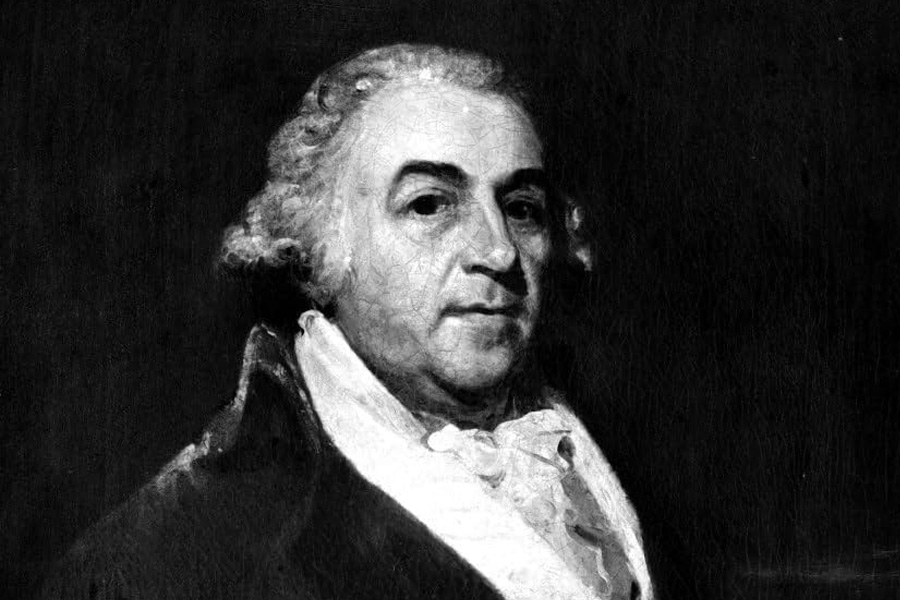
Bache Jr. lives at the crossroads of multiple American stories. Born into the famous Franklin family, he participated in the War of 1812, managed the Philadelphia post office, edited a Democratic journal, and moved to Texas. He was a military volunteer, naval administrator, politician, and state constitution drafter.
His life was similarly mysterious. He left Philadelphia, his wife, and children in the early 1830s. His departure is linked to debt, creditor pressure, or unsubstantiated financial misdeeds during his public service. Official charges have not been filed. He created a second public life in Texas and was recognised for voting against the annexation of Texas to the US in 1845.
A Childhood Among Franklin Family Legends
Richard Franklin Bache was born in Philadelphia on March 11, 1784. His parents were Richard Bache Sr. and Sarah Franklin Bache. His mother was the only daughter of Benjamin Franklin and Deborah Read, making Richard Jr. Franklin’s maternal grandson.
The family house linked business, government, science, and Revolutionary politics. Richard Bache Sr., an English immigrant, became a merchant and maritime insurance underwriter. He succeeded Benjamin Franklin as postmaster general from 1776 to 1782 during the American Revolution.
Sarah Franklin Bache was more than a famous man’s daughter. She helped manage a large household and was known for patriotic and charitable activity during the Revolution. Richard Jr. grew up surrounded by relatives whose names were already woven into the fabric of the new republic.
His relatives included journalist and publisher Benjamin Franklin Bache, Deborah Franklin Bache, who married William J. Duane, and Louis Franklin Bache. Ambition, political debate, and Revolution memories filled the house. Franklin left a legacy, but Richard Jr. did not only follow in his footsteps. It was his goal to enter public life.
Marriage Into the Dallas Family
Richard married Sophia Burrell Dallas at Christ Church in Philadelphia on April 4, 1805. Sophia came from another powerful American family. Alexander J. Dallas, her father, was a distinguished lawyer and treasury secretary under President James Madison. George Mifflin Dallas, her brother, became vice president under James K. Polk.
The marriage joined the Franklin and Dallas families, two networks that reached into government, finance, law, science, and military service. Richard and Sophia had nine children, most of whom were born in Philadelphia.
| Child | Later connection or achievement |
|---|---|
| Alexander Dallas Bache | Physicist, educator, and superintendent of the United States Coast Survey |
| Mary Blechenden Bache | Married Robert John Walker, later secretary of the treasury |
| George Mifflin Bache | United States Navy officer who was lost at sea |
| Richard Bache III | United States Navy lieutenant who drowned |
| Sophia Arabella Bache | Married William Wallace Irwin, a mayor and congressman |
| Matilda Wilkins Bache | Married Army officer William Hemsley Emory |
| Henrietta Constantia Bache | Married into the Abert family |
| Sarah Franklin Bache | Married naval officer Richard Wainwright |
| Maria Campbell Bache | Married Allan McLane |
The family’s later history reads like a directory of nineteenth century American institutions. Its members served in the Navy, Army, Congress, Treasury Department, scientific agencies, and municipal government.
Soldier, Publisher, and Postmaster
Schooled in Philadelphia, Richard graduated from Penn in 1812. Britain and the US went to war that year. Bache founded and captained the Philadelphia volunteer Franklin Flying Artillery. Some reports say he was a US Navy sailing master from 1812 until 1815.
After WWII, Bache entered public administration. As postmaster of Philadelphia in 1815, he followed his father and grandfather. Post office clerical work was noisy. The institution carried political power, commercial information, newspapers, letters, and business correspondence across a rapidly expanding nation.
Around 1819, he also became associated with the Franklin Gazette, a Democratic newspaper published with John Norvell. The paper placed Bache within the energetic partisan press of the era, when newspapers were political weapons as much as sources of information.
For more than a decade, Bache appeared to be firmly established in Philadelphia. He had a prestigious family, a prominent marriage, public appointments, and a growing household. Then the pattern broke.
The Departure for Texas
In the early 1830s, commonly dated to about 1832, Bache left Philadelphia and traveled to Texas. The departure was abrupt, and he did not take his wife and children with him. Sophia remained in the East and outlived him.
The reasons remain uncertain. Financial difficulties and debts are frequently associated with the move. Some accounts mention whispers of irregularities connected with his postmaster service, possibly involving money, but these suspicions were never established as formal charges. The surviving record does not provide a clear verdict.
His departure therefore resembles a door closing in a storm. Behind it stood his wife, children, career, and family reputation. Ahead lay Texas, a distant and unsettled region where he could try to become someone new.
He settled first in Stephen F. Austin’s colony at Brazoria. Later, he moved to Galveston. Texas offered danger, opportunity, and a political landscape still being shaped by revolution.
Service During the Texas Revolution
Bache supported the Texas independence movement in 1836. He served aboard the Texas naval vessel Zavala and joined the Louisiana Independent Volunteers on May 1, 1836, under J. J. Robinson.
He guarded Mexican president and commander Antonio López de Santa Anna after the Texan victory at San Jacinto. This assignment put Bache near one of Texas’ most spectacular events. Since Santa Anna led the Mexican forces during the campaign, his arrest changed the military balance overnight.
Bache’s Texas service was not limited to battlefield activity. In the new Republic of Texas, experienced clerks and administrators were as necessary as soldiers. Governments needed records, departments, customs offices, courts, and naval facilities. Bache found work in this expanding machinery.
A Public Servant in the Republic of Texas
From 1838 to 1839, Bache served as chief clerk of the Texas Navy Department in Houston. He also worked as enrolling clerk of the Texas House of Representatives during the Third Congress of the Republic.
He then became Galveston Navy Yard commissioner, county justice of the peace and customs and imports official. These positions put him at the center of Texas government. He managed ships, revenue, law, paperwork, and the daily needs of a republic to live.
He was civically active in Galveston by the 1840s. His Philadelphia administration experience was important in a society building institutions. Men who could organise, record, examine, and enforce were needed in Texas. Bache spent his youth doing it.
The Annexation Vote of 1845
Annexation split Texas and the US. Joining the US would give security, economic strength, and protection from Mexico, according to supporters. War, slavery, foreign influence, and Texas independence frightened opponents.
American annexation was linked to the 1844 presidential campaign. Democratic James K. Polk backed expansion, while Whig Henry Clay was more cautious. The issue was also strongly sectional. Although Texas was a slaveholding republic, its entrance endangered the equilibrium between free and slave states.
Instead of a treaty, Congress approved annexation by joint resolution. The proposal avoided the two-thirds Senate support needed for a treaty by requiring simple majorities in both chambers. It also permitted Texas to keep its public lands and may split into five states.
Texas accepted the proposal in 1845. At the annexation convention, Richard Bache Jr. cast the sole vote against annexation.
His opposition has often been linked to personal and political reasons, especially his strained relationship with the Dallas family. His brother-in-law, George Mifflin Dallas, was then vice president of the United States. Some later accounts suggest that Bache did not want to enlarge Dallas’s political sphere or share a country with him. That explanation may contain part of the story, but Bache’s vote also reflected the wider questions surrounding Texas sovereignty.
The irony was sharp. A grandson of Benjamin Franklin, whose family had helped create the United States, stood alone in opposing Texas entry into the Union. Yet Bache did not reject public service. He helped draft the Texas Constitution of 1845 and continued working within the new state government.
The Texas Senator
After annexation, Bache served in the Texas Senate for Galveston, identified as District 11. His service extended through the First and Second Legislatures and continued until shortly before his death.
From republic to state requires more than a flag change. Texas had to create US-compatible judicial, taxing, legislative, and administrative structures. Bache helped that shift with his postal, military, customs, and republican government experience.
He died in Austin on March 17, 1848, six days after his sixty fourth birthday. He was buried in Oakwood Cemetery. His grave marker reportedly gives an incorrect death year of 1847.
The Bache Family Legacy
Richard Bache Jr.’s children carried the family name into science, military service, politics, and public administration.
His eldest son, Alexander Dallas Bache, became a physicist and educator. A West Point graduate and professor at the University of Pennsylvania, he later led the United States Coast Survey from 1843 until 1867. Under his direction, the survey grew into a major scientific institution.
Mary Blechenden Bache married Robert John Walker, Polk’s treasury secretary and Kansas Territory governor. Other children married military and political families. Famous Army officer and surveyor William Hemsley Emory. Richard Wainwright was a naval officer. The family was connected to Philadelphia drawing halls, frontier forts, navy warships, scientific labs, and government offices.
In this way, Bache’s legacy was both personal and institutional. He left his wife and children behind, but their accomplishments continued to shape the public world he had once inhabited. His Texas career, meanwhile, gave him a separate identity as a builder of the young state.
Frequently Asked Questions
Who was Richard Bache Jr.?
Richard Bache Jr. was an American military officer, postmaster, newspaper publisher, and Texas politician. He was born in Philadelphia in 1784 and died in Austin, Texas, in 1848.
His mother, Sarah Franklin Bache, was Benjamin Franklin’s only daughter. Richard Bache Jr. was therefore Franklin’s maternal grandson.
Who was Richard Bache Jr.’s wife?
He married Sophia Burrell Dallas in 1805. She was the daughter of Alexander J. Dallas and the sister of George Mifflin Dallas, who became vice president under James K. Polk.
Why did Bache leave Philadelphia?
The exact reason is uncertain. Accounts connect his departure with debt, pressure from creditors, or unproven suspicions about financial irregularities during his time as postmaster. He left his wife and children in the East and moved to Texas.
What did he do during the Texas Revolution?
Bache served with the Texas Navy aboard the Zavala and joined the Louisiana Independent Volunteers. After the Battle of San Jacinto, he helped guard captured Mexican leader Antonio López de Santa Anna.
Why is his annexation vote remembered?
At the 1845 Texas annexation convention, Bache cast the only vote against joining the United States. He nevertheless helped draft the Texas Constitution and later served in the Texas Senate.
How many children did Richard Bache Jr. have?
He and Sophia had nine children. Their descendants and in laws became prominent in science, government, the Army, the Navy, and American politics.